The Irony of Manifest Destiny by William Pfaff
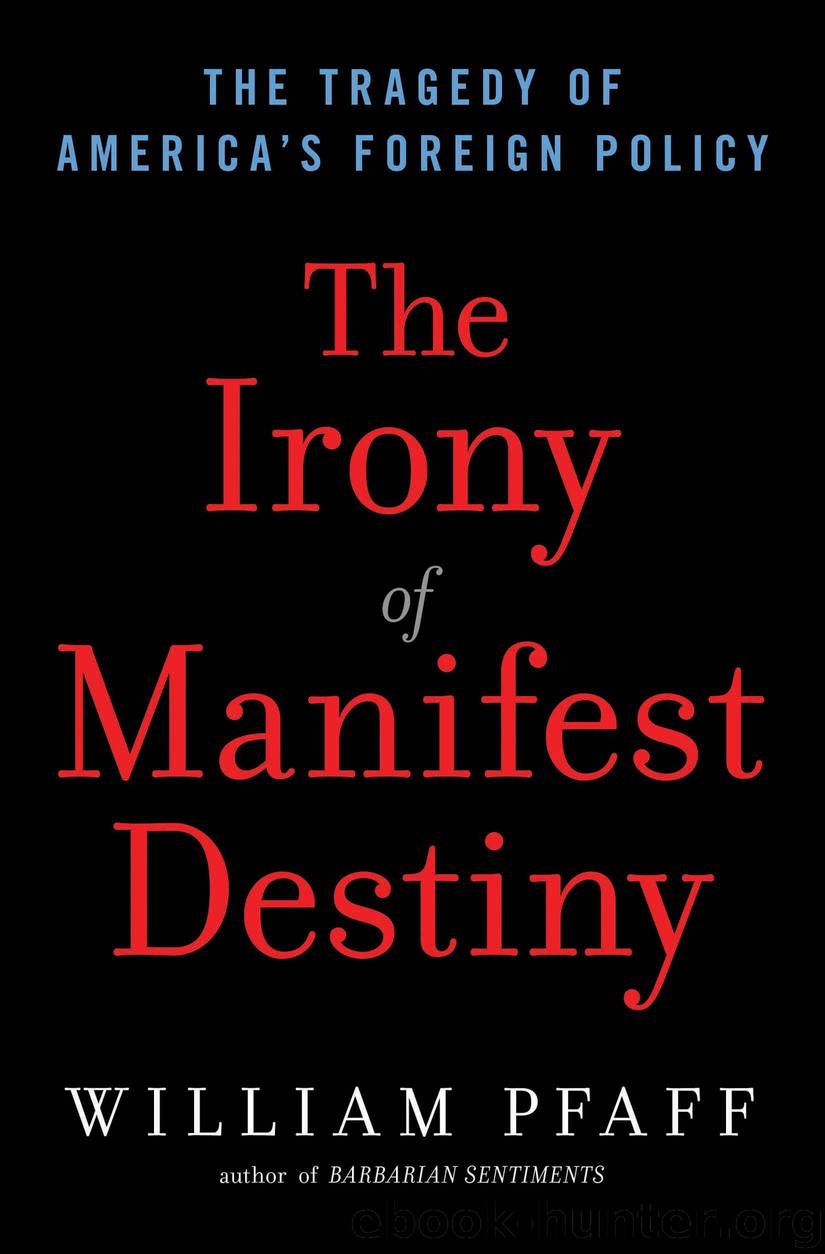
Author:William Pfaff
Language: eng
Format: epub
Publisher: Bloomsbury Publishing Plc
Published: 2010-09-27T04:00:00+00:00
The rivalry between Islam and the European West has existed since the desert Arabs in the seventh Christian century emerged from the Arabian peninsula to confront their neighbors with what they contended were new and final revelations of the monotheistic God. These prophecies provided the doctrinal foundation for a religion preaching and propagating “submission” (the translation of “Islam”) to the will of God in the fullness of his revelation in the Qur’an, acceptance of divine judgment, and seeking of salvation. Muhammad’s message inspired the prefeudal pastoral and agricultural peoples of Mecca and Medina to overrun and convert neighboring Syria and Iraq and go on successfully to challenge the Christian Byzantines, the Persians, the Egyptians, and the Western Christians. They proposed not only a seemingly progressive religion but a political association that demanded the payment of tribute on the one hand, but on the other hand guaranteed security of persons and property and offered communal autonomy.
The Arabs of the great caliphates that developed in Damascus and Baghdad carried out a phenomenal military and imperial expansion that rapidly reached Kabul, Bukhara, and Samarkand in the east and in the eighth century took the Sind in what now is western Pakistan, took a part of Punjab, and invaded China. They blockaded Byzantine Constantinople and expanded westward along the southern coast of the Mediterranean. Carthage and eventually Tangier were seized, and peace and an alliance were made with the Berbers. Next was conquest of Spain by a mixed force of Arabs and Berbers, until resistance survived only in the mountains of Asturias. France was invaded, the Pyrenees were crossed, and Narbonne was taken, an expansion halted only at the battle of Poitiers (732–733), which was fought by the Frankish Charles Martel, grandfather of Charlemagne. Charlemagne’s counterattack came in 778, but his forces were ambushed in the Pyrenees by the Basques; the event was chronicled in what we know as the Song of Roland, in which the knight Roland and the flower of Frankish chivalry perished. (This was five hundred years before the Crusades.)
The astonishing political and military achievement of the Arabs in so rapidly establishing an empire extending from the Atlantic to Central Asia incorporated many separate peoples, including Christians and Jews, and adapted and made use of the intellectual and scientific achievements of Greek civilization, translated into Arabic. The version that emerged in Andalusia of this distinctive Muslim civilization was undoubtedly the most imposing achievement of the early Middle Ages, without counterpart among the more backward Christian Europeans until the time of the Renaissance, to which the Arab revival of classical civilization contributed. The American historian David Levering Lewis writes:
Muslim Europe and Christian Europe faced each other in a delicate equipoise at the great Pyrenees divide. Andalusia’s golden age unfolded in the reign of the remarkable amir and [Umayyad dynasty] caliph ’Abd al-Rahman III. His palace city on the slopes of the Sierra de Córdoba, three miles northwest of the Andalusian capital, was an architectural hyperbole whose remains beggar Versailles as, in the
Download
This site does not store any files on its server. We only index and link to content provided by other sites. Please contact the content providers to delete copyright contents if any and email us, we'll remove relevant links or contents immediately.
| Anthropology | Archaeology |
| Philosophy | Politics & Government |
| Social Sciences | Sociology |
| Women's Studies |
The Secret History by Donna Tartt(19291)
The Social Justice Warrior Handbook by Lisa De Pasquale(12222)
Thirteen Reasons Why by Jay Asher(8992)
This Is How You Lose Her by Junot Diaz(6954)
Weapons of Math Destruction by Cathy O'Neil(6362)
Zero to One by Peter Thiel(5863)
Beartown by Fredrik Backman(5835)
The Myth of the Strong Leader by Archie Brown(5550)
The Fire Next Time by James Baldwin(5501)
How Democracies Die by Steven Levitsky & Daniel Ziblatt(5271)
Promise Me, Dad by Joe Biden(5189)
Stone's Rules by Roger Stone(5128)
A Higher Loyalty: Truth, Lies, and Leadership by James Comey(5017)
100 Deadly Skills by Clint Emerson(4968)
Rise and Kill First by Ronen Bergman(4833)
Secrecy World by Jake Bernstein(4794)
The David Icke Guide to the Global Conspiracy (and how to end it) by David Icke(4770)
The Farm by Tom Rob Smith(4545)
The Doomsday Machine by Daniel Ellsberg(4538)
